【ELSI】What ancient Mars’s rocks reveal about its buried carbonate stores
- ELSI
- Articles
- Space Humanity
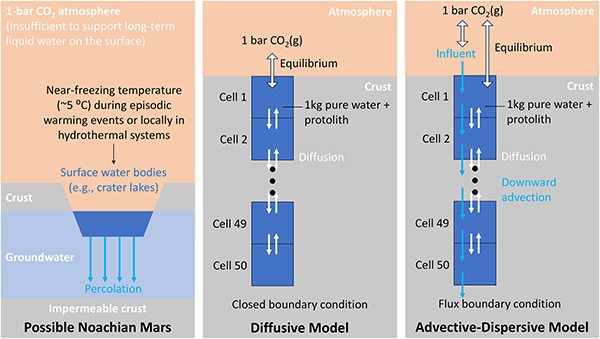
Mars once had abundant liquid water, yet orbiters and rovers have found far less carbonate rock than expected for a planet that may have had a thick, carbon dioxide-rich atmosphere. A new geochemical modelling study led by Chang-Chin Wang, with Professor Tomohiro Usui at JAXA and the University of Tokyo, and Associate Professor Mohit Melwani Daswani at ELSI, shows that the type of rock water reacts with, not just water itself, controls whether calcium/iron-rich or magnesium-rich carbonates form. Feldspar-rich rocks, increasingly detected on the Martian surface, readily produce the calcium/iron-rich carbonates seen in many locations. The simulations also show how percolating groundwater could be quietly burying carbonates underground, helping explain their apparent scarcity on the surface.
Reference
C. Wang, T. Usui, and M. Melwani Daswani. Alteration of Feldspar-Rich Rocks on Ancient Mars and Its Possible Link to Ca/Fe-Rich Carbonates J Geophys Res Planets DOI: 10.1029/2025JE009358
Full text of the press release
Visit the ELSI website.