【ELSI】How Enceladus’ ocean spray becomes chemically diverse ice grains
- ELSI
- Articles
- Space Humanity
Saturn’s icy moon Enceladus hides a global ocean beneath its frozen surface. From fractures near its south pole, material from this ocean is ejected into space as a plume of water vapour and ice particles. These particles offer scientists a rare opportunity to investigate an extraterrestrial ocean without drilling through kilometres of ice.
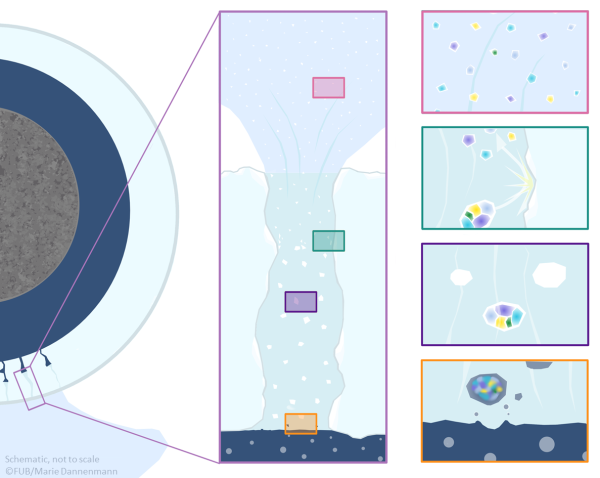
Fig. Enceladus’ ocean material erupts into space
Artist’s rendering of Saturn’s icy moon Enceladus, showing a plume of ice particles and water vapour erupting from fractures near its south pole. Material originating from the moon’s subsurface ocean travels through these icy vents before being ejected into space. The new study suggests that ocean droplets freeze slowly during this journey, allowing salts to separate before the frozen droplets fragment into the chemically diverse ice grains detected by NASA’s Cassini spacecraft. The illustration is based on observations from the Cassini mission.
Credit: NASA/JPL-Caltech
Now, an international research team including scientists from the Earth-Life Science Institute (ELSI) at the Institute of Science Tokyo has uncovered how ocean water may be transformed on its journey from the subsurface ocean into the tiny ice grains observed in space.
To investigate, Professor Yasuhito Sekine and colleagues at ELSI conducted laboratory experiments using droplets designed to reproduce the major salt components expected in Enceladus’ ocean. The team froze droplets of different sizes at different cooling rates and examined how their constituent elements were distributed after freezing.
The experiments revealed that cooling rate matters. In droplets around 200 micrometres across, salts became spatially separated when the droplets froze slowly, at approximately 10 K per minute or less. Faster freezing produced a much more uniform distribution.
Reference
Frank Postberg, Zenghui Zou, Yasuhito Sekine, Minori Koga, Jürgen Schmidt, Mark Fox-Powell, Fabian Klenner, Jon K. Hillier, Nozair Khawaja, Toshihiko Kadono, Melih Çakar, Sascha Kempf, Ralf Srama. Cassini CDA observes compositional segregation of Enceladus’ ice grains from slow freezing and fragmentation of oceanic spray Science Advances DOI: 10.1126/sciadv.aee7256
The full press release is available on this page.
For more information on ELSI, please visit the website.