【ELSI】The hidden economics of cellular energy
- Social Phase Transition
- ELSI
- Articles
Every living cell relies on molecular “currencies” such as ATP, GTP and NAD(P)H to transfer energy and coordinate metabolism. Although these molecules perform different cellular functions, they are chemically connected, making their independent regulation surprisingly difficult. Researchers at ELSI and collaborators developed a new theoretical framework showing that cells face a fundamental tradeoff: maintaining multiple energy currencies at similar abundances allows more precise metabolic control, but requires greater energy dissipation. The work offers a thermodynamic explanation for why cells organise their energy economy the way they do and suggests a new link between metabolism, environmental complexity and the evolution of microbial genomes.
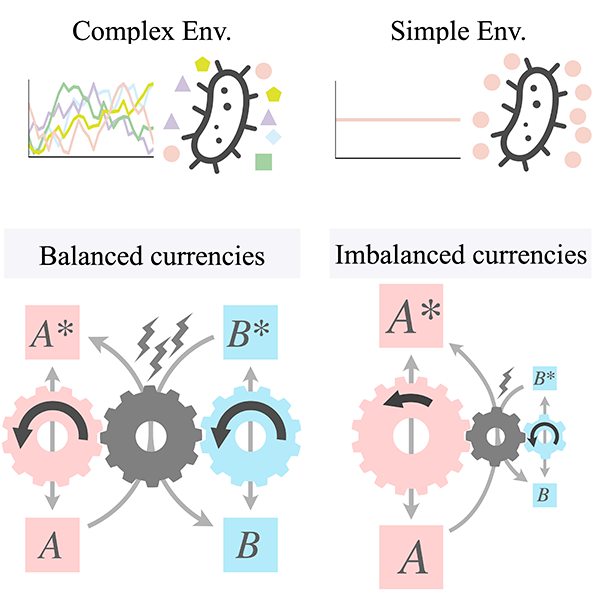
Image. The balance of cellular energy currencies influences controllability and cost in metabolism.
The theory predicts that balanced energy currencies enable greater metabolic control, but require more thermodynamic dissipation. In simpler environments, imbalanced currencies can reduce this cost, albeit at the expense of metabolic flexibility, and vice versa.
Credit: Yamagishi, J.F. et al., PRX Life (2026)
Reference
Jumpei F. Yamagishi and Tetsuhiro S. Hatakeyama. Thermodynamic Cost-Controllability Tradeoff in Metabolic Currency Coupling PRX Life DOI: 10.1103/4bqh-zhry
The full press release is available on this page.
For more information on ELSI, please visit the website.