【11/13開催】食の進化/CWRA「エネルギー転換を駆動する心理と社会構造」
- Event
- news
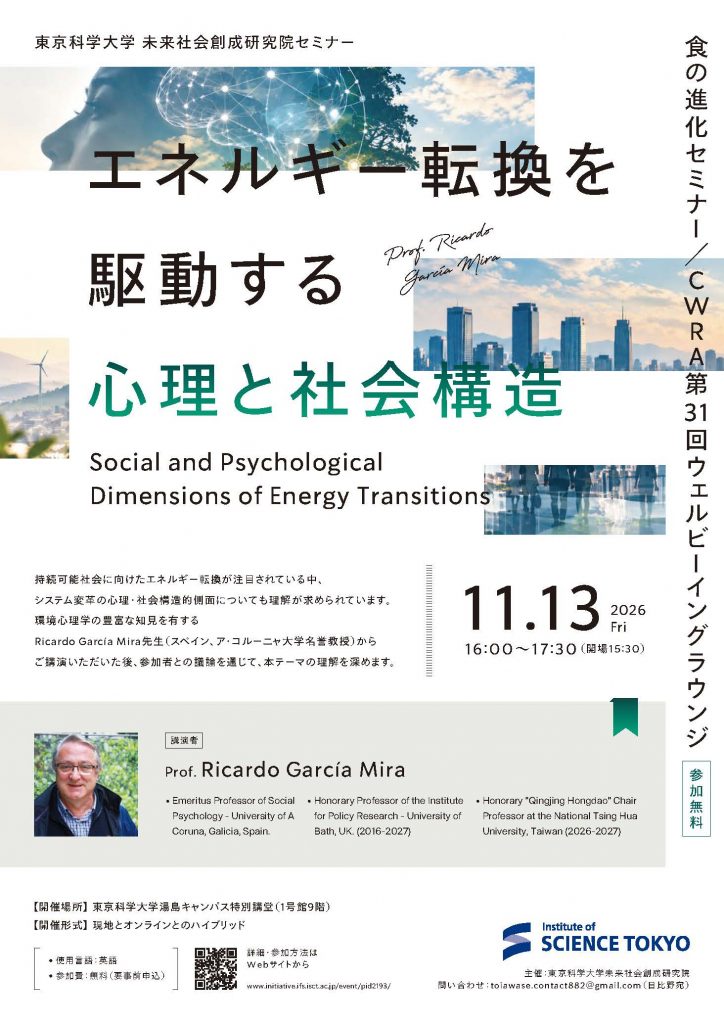
食の進化イニシアチブセミナー/CWRA第31回ウェルビーイングラウンジ
「エネルギー転換を駆動する心理と社会構造 SOCIAL AND PSYCHOLOGICAL DIMENSIONS OF ENERGY TRANSITIONS」
スペイン、ア・コルーニャ大学名誉教授で環境心理学がご専門のRicardo García Mira先生をお招きしてセミナーを開催します。持続可能社会に向けたエネルギー転換が注目されている中、システム変革での心理・社会構造的側面についても理解が求められています。環境心理学の豊富な知見を有するGarcía Mira先生からご講演いただいた後、参加者との活発なディスカッションを通じて、本テーマの理解と議論を深めます。皆様の参加を心からお待ちしています。
開催概要
開催日時:2026年11月13日(金) 16時~17時30分 (開場15時30分)
開催形式:現地とオンラインとのハイブリッド
開催場所(現地):東京科学大学湯島キャンパス特別講堂(1号館9階)
使用言語:英語
参加費:無料
参加登録:事前に参加登録をお願いします。
現地参加現地参加については、こちらのフォームよりお申込みください。
オンライン参加(Zoom Meeting)については、こちらのLinkよりお申込みください。
講演者
Prof. Ricardo García Mira
- Emeritus Professor of Social Psychology - University of A Coruna, Galicia, Spain.
- Honorary Professor of the Institute for Policy Research - University of Bath, UK. (2016-2027)
- Honorary "Qingjing Hongdao" Chair Professor at the National Tsing Hua University, Taiwan (2026-2027)

主催:東京科学大学未来社会創成研究院
問い合わせ toiawase.contact882 [at] gmail.com(日比野宛)
[at]を@に変更してお送りください
概要
Decarbonisation of economies has become a major policy focus in many European
countries to meet carbon emission targets as outlined in the Paris agreement.
However, the discontinuation of large-scale carbon intensive industries may cause a
local disruption of the economy and reduce the source of income and employment for
a large part of the population in coal- and carbon-intensive regions, which in turn will
accelerate the process of de-territorialisation as indicated in citizens leaving the
regions. The European commission has promised a just transition for these regions, so
that nobody feels left behind in this transition, but the actual impact of
decarbonisation measures on the psychological level still requires more scrutiny. In this
seminar, we will analyse the psychological impact of decarbonisation measures and
their relation with place attachment on people’s intentions to migrate from these
regions and their level of overall life satisfaction, which are important driving factors
for the de-territorialisation process. We also will explore the impact of gender, age,
education, nativity and duration of stay in the region on their decision to migrate and
their level of life satisfaction. Results derived from the exploration of data from a
quantitative survey (n =2892) in 13 coal- and carbon-intensive regions in 9 European
countries will be discussed, using a structural equation modelling approach with
subgroup analyses. In these analyses, we will see how place attachment plays an
important role in increasing life satisfaction and reducing the intention to relocate,
while perceived stress and financial threats