【13th Nov.】EEI/CWRA “SOCIAL AND PSYCHOLOGICAL DIMENSIONS OF ENERGY TRANSITIONS”
- Event
- news
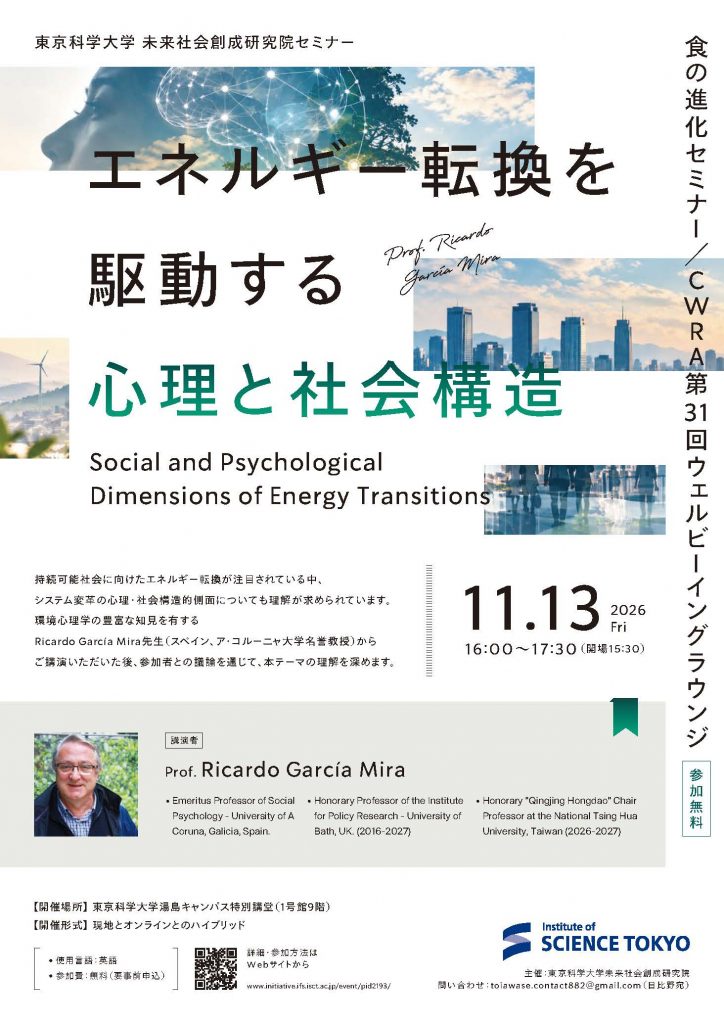
The Evolutions in Eating Seminar / The 31st CWRA Wellbeing Lounge
We are pleased to announce that this seminar will feature Dr. Ricardo García Mira, Professor Emeritus of Environmental Psychology at the University of A Coruña, Spain. As the energy transition toward a sustainable society gain increasing attention, there is a growing need to understand the psychological and social-structural aspects of systemic change. Dr. García Mira, a leading expert in environmental psychology, will deliver a lecture, followed by an interactive discussion with participants to further explore and deepen engagement with the theme.
We warmly invite you to join us for this event.
SEMINAR DETAILS
Date and Time: Friday, November 13, 2026, 16:00 - 17:30 (Doors open at 15:30)
Format: Hybrid on-site and online
Location: Institute of Science Tokyo Yushima Campus Special Auditorium (Building 1, 9th floor)
Language: English
Participation fee: Free
Registration: Advance registration required.
To attend in person, kindly register using this form.
To attend online (via Zoom Meeting), kindly register using this link.
SPEAKER
Prof. Ricardo García Mira
- Emeritus Professor of Social Psychology - University of A Coruna, Galicia, Spain.
- Honorary Professor of the Institute for Policy Research - University of Bath, UK. (2016-2027)
- Honorary "Qingjing Hongdao" Chair Professor at the National Tsing Hua University, Taiwan (2026-2027)

Contact: toiawase.contact882 [at] gmail.com
Aiko Hibino(Evolutions in Eating initiative, Institute of Future Science, Institute of Science Tokyo)
ABSTRACT
Decarbonisation of economies has become a major policy focus in many European countries to meet carbon emission targets as outlined in the Paris agreement.
However, the discontinuation of large-scale carbon intensive industries may cause a local disruption of the economy and reduce the source of income and employment for a large part of the population in coal- and carbon-intensive regions, which in turn will accelerate the process of de-territorialisation as indicated in citizens leaving the regions. The European commission has promised a just transition for these regions, so that nobody feels left behind in this transition, but the actual impact of decarbonisation measures on the psychological level still requires more scrutiny. In this seminar, we will analyse the psychological impact of decarbonisation measures and their relation with place attachment on people’s intentions to migrate from these regions and their level of overall life satisfaction, which are important driving factors for the de-territorialisation process. We also will explore the impact of gender, age,
education, nativity and duration of stay in the region on their decision to migrate and their level of life satisfaction. Results derived from the exploration of data from a quantitative survey (n =2892) in 13 coal- and carbon-intensive regions in 9 European countries will be discussed, using a structural equation modelling approach with subgroup analyses. In these analyses, we will see how place attachment plays an
important role in increasing life satisfaction and reducing the intention to relocate, while perceived stress and financial threats.