【EEI】【DLab⁺】Evolutions in Eating Workshop “Future and Meat?”
- Events
- Future of Humanity Research Center
- Evolutions in Eating
On 21 November 2025, we welcomed Professor Shoji Takeuchi (Graduate School of Information Science and Technology, The University of Tokyo) to discuss what the new forms of food brought about by technology might look like. The day was also the opening of “Moshimo (What if): a laboratory for the city and the future," the new base of the Institute for Future Society, and a lively exchange of views took place in this newly completed space.
For this workshop, Professor Takeuchi gave a lecture under the title "Future and Meat?" In recent years, cultured meat — produced by growing cells outside the animal body — has been attracting attention. The Takeuchi Lab has been a leader in micro- and nano-device technology, and is also well known for applying that technology to research on cultured meat.
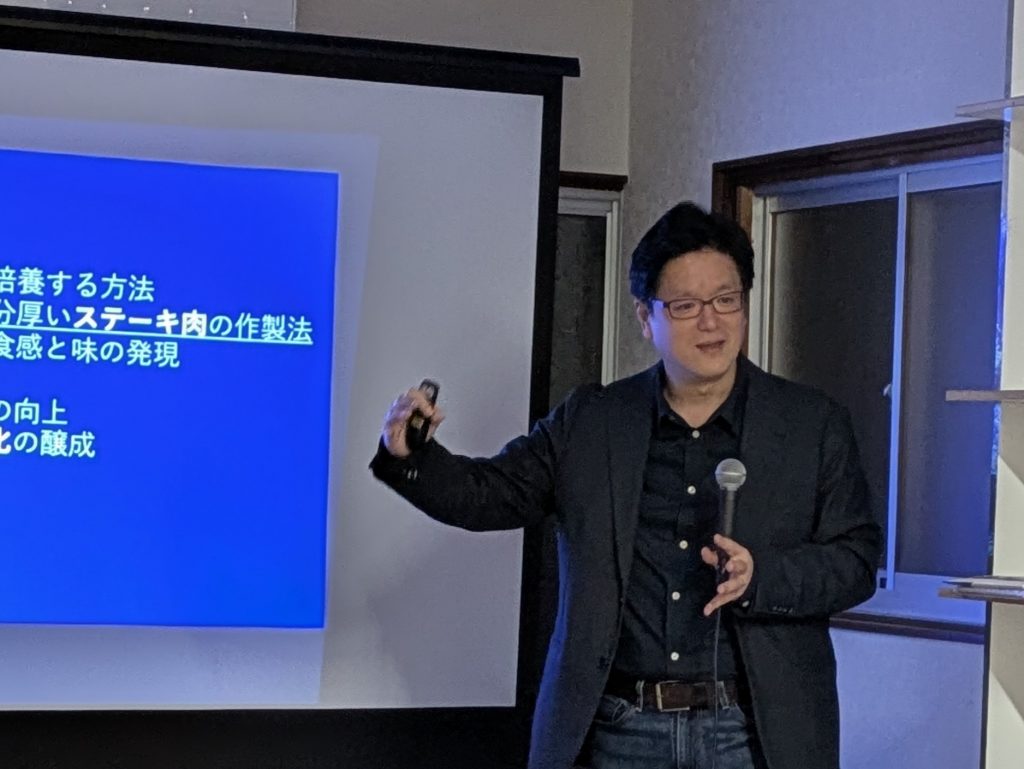
The lecture began with an explanation of the background to why cultured meat is needed.
Methods of producing meat other than conventional livestock farming are being explored in order to supply sufficient protein for a growing population, to secure a stable regional food supply, and to address challenges such as the risk of infectious disease and animal welfare. Cultured meat is one of the approaches on which hopes are placed. In Singapore, cultured chicken has already been commercialized and can be obtained in retail stores, but the proportion of cultured cells it contains is low, and in practice it remains close to soy-based meat.
Against this backdrop, the Takeuchi Lab is aiming to create "real meat." Real meat — that is, structured meat with properly aligned muscle fibers, made by drawing on the knowledge and techniques of regenerative medicine — and the method of making it was explained in accessible terms. The lab has devised a device and a method that grow cells by stacking sheets, and a major distinguishing feature is that it produces three-dimensional tissue. It was explained that the strength of this method is that it can produce meat close to the real one: muscle that moves under electrical stimulation. In 2019 the lab announced a one-centimeter cube of cultivated steak, and in 2022 it also became possible to actually eat it. Professor Takeuchi shared an anecdote as well: when asked on a television broadcast for his impressions after actually tasting cultured meat, he had been moved, but since it was not very tasty, he was unable to offer a favorable comment.
The lecture also addressed the challenges of spreading cultured meat in the years ahead. In addition to improving the technology, it will be necessary to develop regulation and to create a new food culture.
At the end of the lecture, a vision for the technology extending beyond meat was presented. In Professor Takeuchi's conception, robots will move by muscle in the future. Human-like robots — robots covered in the same material as human skin — will also appear. As biohybrid robots that join living organisms and machines become possible, a range of possibilities opens up. For example, a delicious, "edible" robot that comes toddling over and offers itself to be eaten by a human — such a vision of the future was also presented
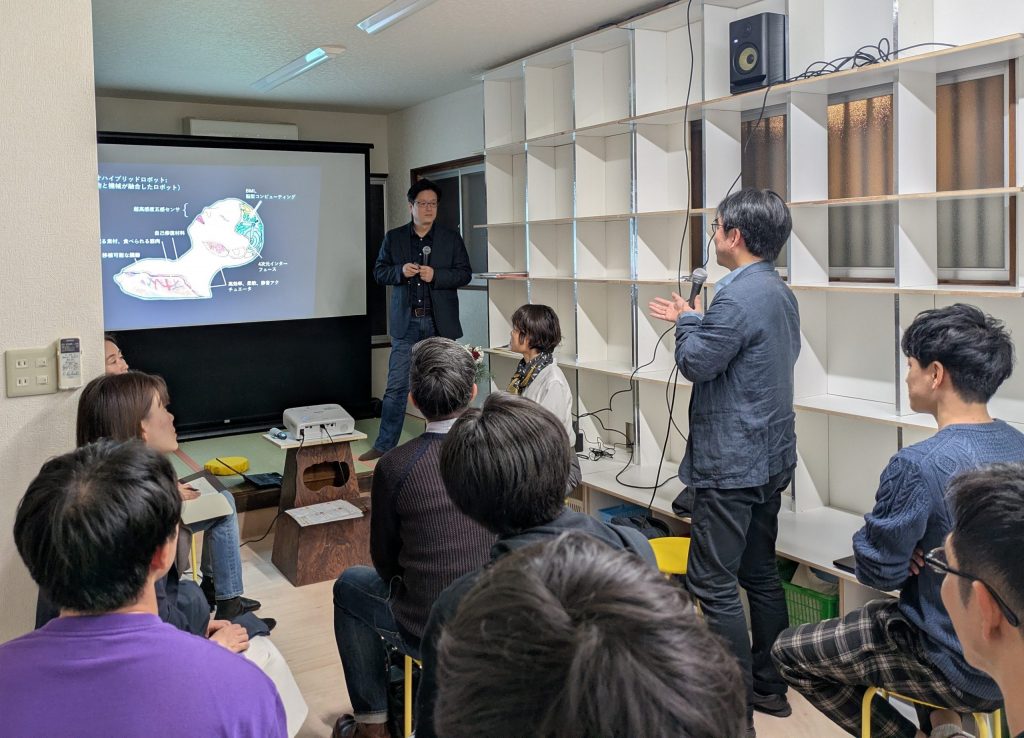
Many questions were put to Professor Takeuchi in response to his talk. For example, the intriguing questions about the background of the technology were: given assessments that developing cultivated meat and edible robots is costly, how should the significance of such technology be understood; might humans themselves become cyborgs; how far, and what kinds of, functions can be added, and how does that connect to form; and could bacteria live in a hybrid robot.
Questions and answers continued during the discussion session after the break. There were questions such as what other phenomena might the proliferation of cells in producing cultivated meat be said to resemble; what is interesting is how technology will change desire in the future, so what feelings does he (Professor Takeuchi) hold towards a robot with muscles that he himself made, and how might this change people's desires; and technologies such as 3D food printers are also appearing, so what are the foods that only cutting-edge technology can make. Those questions led into a discussion of the characteristics of the technology and the effects it brings to society.
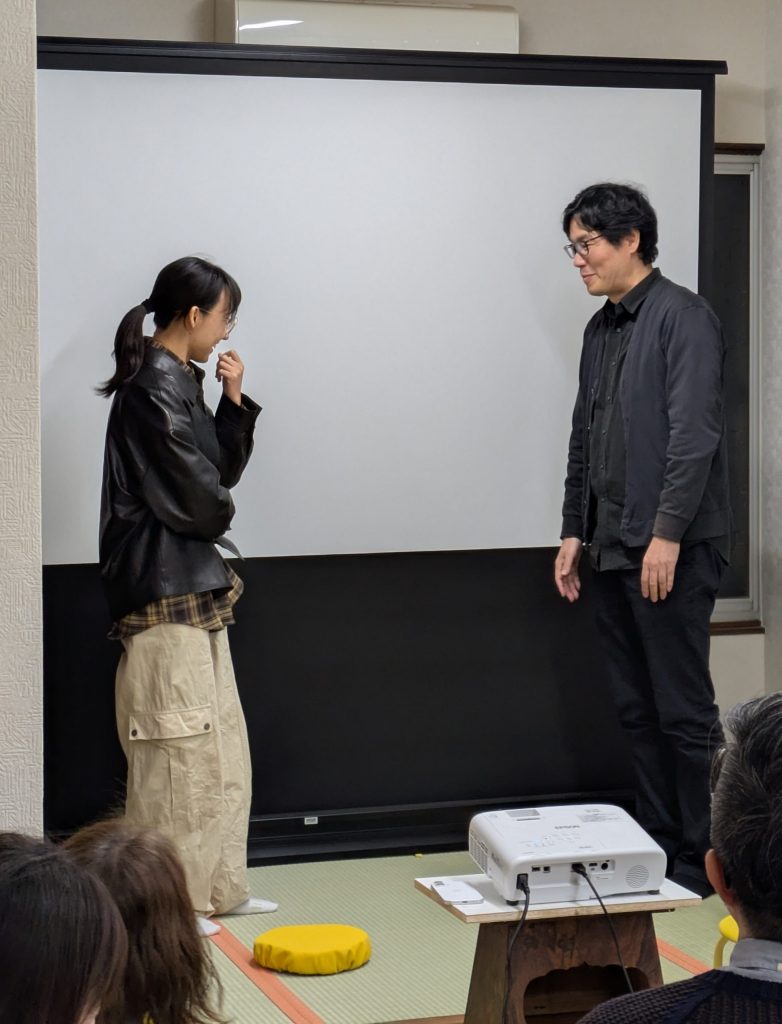
Midway through the discussion, Professor Takashi Takao (Institute for Liberal Arts, Institute of Science Tokyo) and students from the Takao seminar performed an impro (improvisation) piece on the motif of an "edible robot," and the room was greatly enlivened. In improv there is no script, and the performers advance the play by ad-libbing on the spot. In a world where food has run out, a robot offers itself to a human, saying "Please eat me." The human at first declines — "No, it's all right, I'm fine" — but the robot persuades the human, saying "If you don't eat, you will die." Hesitating, the human asks the robot, "But how do I eat you?" (an outline of the improv up to this point). Professor Takeuchi expressed his admiration, remarking that this was exactly the kind of scene and story he had been imagining.
Prompted in part by the story of the improv, there was discussion of what the problems with edible robots are. Reference was made to the possibility that a human form would be shunned, to the point that the moment of transition from life to death is important, and to cases in which a robot ceases to be mere matter through interaction. A participant also presented a novel of their own writing.
The aim of this workshop was to survey the breadth of the issues surrounding the activity of "eating," and through the lecture and the discussion we were able to bring a range of highly interesting issues to the surface.。