【EEI】【CWRA】Evolutions in Eating Workshop and 19th Well-being Lounge, “Changes in Rainforest Hunting and the Food Culture of Wiled meat”
- Planetary Wellbeing
- Events
- Future of Humanity Research Center
- CWRA
- Evolutions in Eating
Evolutions in Eating Workshop / 19th Well-being Lounge: "Changes in Rainforest Hunting and the Food Culture of Wiled meat"
Date and time: Friday, 5 December 2025, 16:00–18:00
Speaker: Associate Professor Shun Hongo, Research Institute for Humanity and Nature / Kyoto University
Theme: Evolutions in Eating Workshop, "Changes in Rainforest Hunting and the Food Culture of Wiled meat"
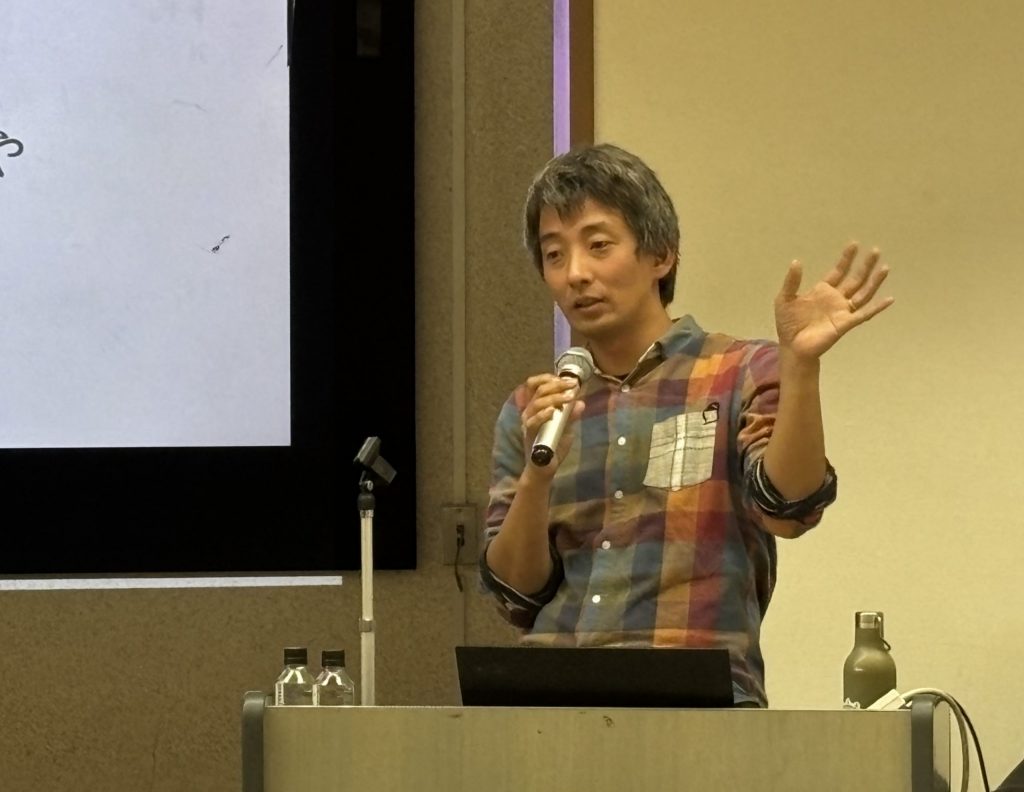
On 5 December 2025, we welcomed Associate Professor Shun Hongo (Associate Professor, Research Institute for Humanity and Nature / Program-Specific Senior Lecturer, Hakubi Center for Advanced Research, Kyoto University) to discuss what meaning “wiled meat” holds within culture. The workshop was held at the Special Lecture Hall of the Yushima Campus, Institute of Science Tokyo, and views were exchanged from a variety of perspectives.
For this workshop, Dr Hongo gave a lecture under the title "Changes in Rainforest Hunting and the Food Culture of Wiled meat." His background is ecology, and he researches the ecology and conservation of wild animals, centered on the African region. In recent years he has served as leader of a large-scale interdisciplinary project, “Fair and Sustainable Hunting Management through Dialogues between Local Knowledge and Science,” working towards the reconciliation of wildlife conservation with the hunting livelihoods and cultures of local residents in tropical rainforests around the world.
The lecture opened with an explanation of wiled meat. Wiled meat is defined as the edible portion of wild vertebrates, excluding fish. This definition focuses not on components such as muscle and fat but on whether something can be eaten, and may therefore be called an anthropocentric definition. It was also noted that, from the findings of primatology, among primates alive today almost all species other than humans do not eat meat. Evidence that humans habitually ate meat begins to appear around two million years ago, and the fact that the boundary zone between savannah and rainforest became a site of human activity is thought to be connected to the beginning of meat eating.
The lecture went on to introduce the realities of hunting wild animals in the tropical rainforest. In the rainforests of Central Africa, hunting techniques became more efficient from the twentieth century onwards, and iron wire snares and shotguns came into use. With the spread of wire snares, medium-sized mammals became the main target. In the Amazon, by contrast, a distinguishing feature is that guns arrived at an earlier period. The volume of wiled meat produced in the Amazon is nevertheless smaller than in Africa. Photographs and video of actual hunting scenes were also shown during the lecture; the video of hunting with a spear conveyed a strong sense of immediacy.
On the food culture of wiled meat, it was explained that a wide variety of wild animals are eaten in both Africa and the Amazon. Wiled meat is in many cases boiled. It appears to be served with thick plant-based sauces or simmered in hot water. Eating wiled meat is also bound up with the maintenance of social norms. Among the Baka people of Africa, for example, there is a rule that the person who first brings down an elephant may not eat its meat, and such rules are said to maintain equality within the society. While wiled meat may carry a strong image as an indispensable source of income for residents, Dr Hongo emphasised that in practice it is combined with other resources and plants in cooking and carries a strongly cultural character.
The research project that Dr Hongo is pursuing was also introduced. Against the background of demand in urban areas and other factors, there is currently concern that too much wiled meat is being taken. Two directions exist for addressing the problem: conservation that establishes protected areas and prohibits hunting, and conservation that involves dialogue with and participation by residents. The project aims at the latter form of conservation, with researchers and local hunters cooperating to monitor wildlife numbers and to devise management that regulates hunting. It regards residents as experts grounded in experience, and aims to generate knowledge jointly.
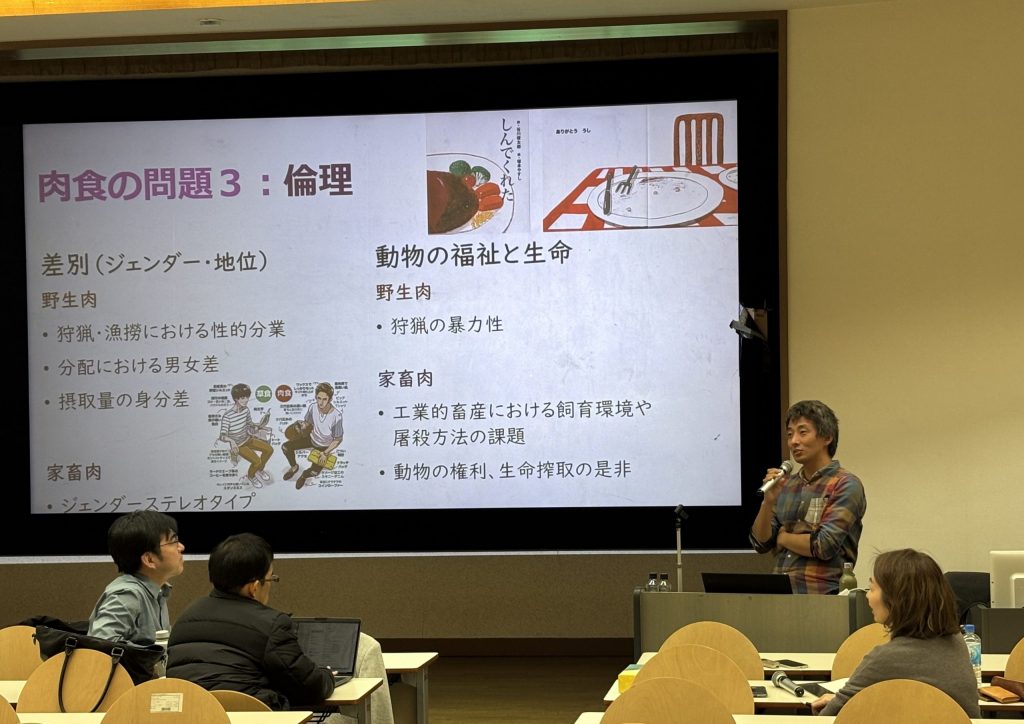
At the end of the lecture, a schema of the issues for thinking about the future of meat eating was proposed. It was pointed out that it is necessary to distinguish wiled meat from livestock meat, and that it is important to examine the environmental (biodiversity and so on), health (infectious disease and so on), and ethical dimensions attending each.
A lively question-and-answer session unfolded during the discussion. Questions such as how far the desire directed at wiled meat in local areas and the desire for meat eating in urban areas coincide, and in what respects they differ; and how much protein other than meat can be obtained in these local areas, served to clarify the position of meat within the region. On this point, Associate Professor Hongo explained that hunters in rural areas also have a desire for hunting itself — to become skilled at taking game well — and described how, through learning to hunt, they come to acquire an identity within their culture.
There were also questions touching on the biological background of meat eating, such as why human beings came to eat meat, and how it is determined (among animals other than humans) whether members of the same species are eaten or not eaten, killed or not killed; these were addressed from the perspective of evolutionary theory.
To questions such as whether hunting numbers had been in balance before commercial hunting arrived; whether there simply exists a motivation to refrain from hunting because wild animals are decreasing; whether it is not difficult to advance the project when residents lack motivation towards biodiversity conservation; and what those who earn wages from hunting spend that money on, detailed explanations were given of the background of the survey areas, of residents' perceptions, and of the challenges the project faces.
Other intriguing questions included how biodiversity is evaluated, given that there are various axes of evaluation; whether the bear problem that has become an issue in Japan could also be resolved through hunting and eating; and whether religious meaning is attached to meat. These deepened understanding of the theme as a whole.
Meat eating tends to be discussed on the premise of consumption in urban areas, but through this workshop on wiled meat we were able to confirm the importance of the act of taking meat, and how deeply it is bound up with local culture and with the ecology and conservation of animals.
For more information on CWRA, please visit the website.